

Franchise Growth Framework
How to recruit multi-unit franchisees
Are you looking for “experienced multi-unit operators who are looking to add their portfolio.”? Unless you distinguish between Tier 1, Tier 2, and Tier 3 operators, you aren’t going to succeed.
The issue is not your brand. It is your process.Your recruitment and sales processes are still designed for single-unit operators. Multi-unit operators recognize this immediately.We call this a Tier mismatch.
It is misalignment.
In most cases, this happens before a serious conversation even begins—because the opportunity is being presented in a way that does not match how these experienced multi-unit operators evaluate it.
This mismatch has measurable consequences.
Franchisors invest in lead generation, generate interest, and move prospects into the pipeline—only to see the most qualified candidates fail to sign a franchise agreement & open units.
The problem is not the operators. It is that your offering is being framed at the wrong level.
Multi-unit operators evaluate unit economics, territory structure, operational complexity, system strength, and long-term exit potential.
If those elements are not clearly presented as part of a scalable system, the opportunity is filtered out early—often before a serious conversation begins.
Based on our experience, we outline how multi-unit franchise operators actually evaluate opportunities—and where franchisors typically lose them.
We introduce a simple classification framework—Tier 1, Tier 2, and Tier 3 operators—to clarify how different buyers think, and why most franchise recruitment systems are still built for Tier 1 decisions.
Most franchisors recognize this distinction conceptually, but still struggle with the practical implication: their marketing continues to attract the wrong tier of operator.
To correct this, we show how to align recruitment, messaging, and the sales process with the logic of operators who build and scale portfolios.
Core idea: Most franchisors claim to want Tier 2 and Tier 3 operators, but much of their material is still written for Tier 1 thinking. That mismatch generates interest, but often fails to convert.
1. Definition
What Are Multi-Unit Franchise Operators?
Multi-unit franchise operators are franchisees or operating groups capable of opening, managing, and scaling more than one location. In smaller cases, this may mean two or three units. In larger cases, it may involve development agreements, enterprise-level operating platforms, multi-brand portfolios, and institutional backing.
The phrase sounds simple, but in franchising it often hides an important distinction. Franchisors use “multi-unit” to describe future growth within their own brand. Suppliers and broader market participants often use terms like MUMBO to describe operators who already own multiple units across multiple brands.
These are not identical categories. A franchisor may be recruiting someone to become a multi-unit operator inside one brand. But the most sophisticated buyers often think like portfolio allocators, not just expansion-minded owner-operators.
This creates a lexicon problem. Many franchisors speak as though all multi-unit operators are the same. In practice, there are distinct tiers of operators, and each tier uses a different decision framework.
Lexicon note: “Multi-unit” and “MUMBO” are often used loosely in the market, but they should not be treated as perfect synonyms.
From a franchisor’s perspective, “multi-unit” often means growth within one system. From an operator’s perspective, especially at the upper end, the real question is how capital is deployed across multiple opportunities.
2. Classification Framework
The Three Tiers of Franchise Operators
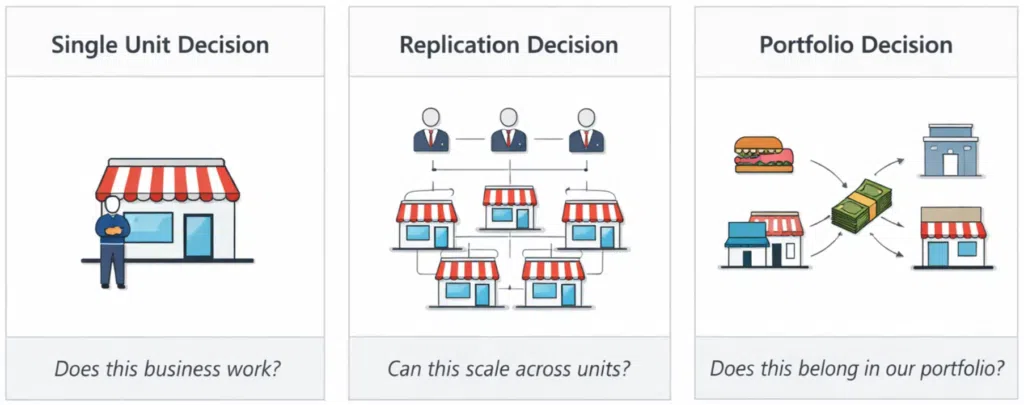
Franchisors often talk about “multi-unit operators” as if they form one class. They do not. In practice, the category covers at least three distinct tiers, each with a different scale, mindset, and decision logic.
Owner-Operator
Typical scale: 1 to 2 units
Tier 1/Owner-Operators are usually focused on building income, creating a manageable operating platform, and succeeding at the unit level. The brand story may matter a great deal because the business is still experienced as a direct operating commitment.
- Often lifestyle and ownership driven
- Evaluates the brand more than the larger system
- Less likely to think in explicit portfolio terms
Platform Builder
Typical scale: 3 to 10 units under a development plan
Tier 2/Platform Builders are focused on replication. They want evidence that the model can scale, that territory design is coherent, and that the economics hold across several openings. They care less about story alone and more about whether a system can be built around the concept.
- Development agreement mindset
- Strong concern for replicability and territory logic
- Usually still more single-brand focused than portfolio operators
Portfolio Operator
Typical scale: enterprise-level growth, often multi-brand
Tier 3/Portfolio Operators evaluate franchise systems as capital allocation opportunities. They compare your brand to other brands, other markets, and other uses of capital. Many already operate at scale, and some are supported by private equity or other institutional capital.
- Portfolio allocation mindset
- Compares returns across opportunities
- May be multi-unit, multi-brand, and professionally managed
Why this matters: Most franchisors say they want Tier 2 and Tier 3 operators. Yet much of their written material, lead handling, and qualification process still speaks to Tier 1 concerns.
3. Pattern Recognition
Key Characteristics of Multi-Unit Franchise Operators
Financial Sophistication
Serious multi-unit operators assess expected return, capital intensity, timing, and downside exposure using a structured evaluation framework . They are not just buying because of enthusiasm for a concept. They want proof or verification of the numbers. Do they work?.
Replication Mindset
They ask whether the business can be repeated across multiple sites without the economics or operations breaking down.
Process Orientation
Strong operators look for systems, not heroics. They want to know whether success depends on a reliable operating model or on extraordinary local talent.
Capital Allocation Perspective
At the higher tiers, the opportunity is assessed against other brands, other deals, and other uses of capital. That is why clear economics matter more than brand storytelling alone.
4. Business Significance
For Franchisors, This Matters Because Multi-Unit Operators:
Can Accelerate Expansion
A qualified multi-unit operator can compress time by signing for a broader territory or a multi-year development plan rather than approaching the system one location at a time.
Bring Operating Infrastructure
Larger operators often arrive with management layers, site development knowledge, financing relationships, and disciplined opening processes.
Create System Leverage
They can strengthen regional density, improve brand visibility, and create a more predictable growth pattern across a market.
Raise the Standard of Recruitment
Recruiting better operators forces franchisors to clarify territory structure, unit economics, qualification standards, and post-signing support.
5. Decision Logic
How Multi-Unit Franchise Operators Think
The common mistake is to assume that multi-unit operators simply like bigger brands or want to “grow with” a franchisor. In reality, they are usually solving a more disciplined problem: where should capital, time, and operating focus be deployed for the best risk-adjusted return?
Portfolio Allocation
Especially at Tier 3, the operator is not making a purely emotional brand choice. The question is how this opportunity compares to other places where capital can be deployed.
Risk Management
Risk is evaluated through unit economics, management complexity, territory coherence, labor demands, financing terms, and the strength of the franchisor’s operating support.
Scalability
The operator asks whether the business can be repeated several times without losing margins, consistency, or managerial control.
System Dependence vs Operator Dependence
Sophisticated operators want to know whether success comes from a strong, teachable system or from exceptional individuals improvising their way to performance.
6. Evaluation Framework
How Multi-Unit Franchise Operators Evaluate Franchise Opportunities
Most serious operators reduce a franchise opportunity to a handful of practical questions. If your materials and recruitment process do not answer them clearly, you may create curiosity without building confidence.
1. Unit Economics
What is the expected return per unit? How fast is payback? Are margins strong enough to justify the build, labor model, and operating complexity?
2. Territory Structure
Can the opportunity actually be developed at scale in a coherent geography? Is the territory large enough, logical enough, and protected enough to justify a plan?
3. Operational Complexity
How hard is the concept to run? What level of staffing, supervision, training, and local operator skill is required to maintain performance?
4. Brand Strength vs System Strength
Is the opportunity dependent on the attractiveness of the brand alone, or is there a robust system that supports consistent execution and repeatable growth?
5. Exit Potential
Does the business create a platform that can later be sold, refinanced, recapitalized, or expanded into something more valuable?
What Many Franchisors Miss
Very few franchisors clearly answer these questions in their materials. Even fewer design their recruitment process in a way that allows larger operators to uncover the answers through serious qualification.
7. Financial Filters
Franchise Economics That Matter to Multi-Unit Franchise Operators
Multi-unit operators do not just want “good numbers.” They want to understand how the economic model behaves across several openings and across time.
AUV and Revenue Quality
Average unit volume matters, but so does consistency across markets, store types, and cohorts.
Store-Level Profitability
Gross margin and store-level EBITDA profile are essential because top-line sales alone do not create a scalable platform.
Payback Period
The operator asks how long it takes to recover invested capital and how resilient that estimate is under stress.
Buildout and Capital Requirements
Construction costs, opening costs, equipment, and working capital requirements all affect whether multi-unit scale is realistic.
Labor Model
Concepts that require exceptional staffing intensity or fragile labor assumptions often become difficult to scale.
Sales Stability
Same-store sales patterns, maturity curves, and demand stability matter because serious operators underwrite volatility, not just upside.
8. Buying Sequence
The Multi-Unit Franchise Operator’s Decision Process or Logic
Recruitment works better when franchisors recognize that commitment emerges in stages. The operator’s logic usually moves from awareness to validation, then from validation to structured commitment.
Awareness
The operator first becomes aware of the brand through thought leadership, reputation, peer reference, LinkedIn visibility, broker contact, or event-based exposure.
Initial Interest
The concept appears worth a closer look. The operator asks whether the category, economics, and growth posture justify further attention.
Qualification
The buyer begins to test whether the opportunity matches capital capacity, operational bandwidth, geographic priorities, and strategic intent.
Validation
The operator seeks confirmation through economics, market logic, conversations with leadership, validation with franchisees, and practical evidence of system strength.
Deal Structuring
Territory, timing, development obligations, capital schedule, and risk allocation are worked through in a more formal way.
Commitment
The decision is made when the operator concludes that the brand fits both the economics and the strategic logic of deployment.
9. Diagnostic Section
What Franchisors Get Wrong About Multi-Unit Franchise Operators
Overemphasizing Brand Story
Story has value, but larger operators need economics, territory logic, and replicability. Inspiration without substance does not support commitment.
Underestimating Financial Sophistication
Many systems present numbers too vaguely or defensively. Serious operators want clarity, not slogans.
Weak Qualifications
Recruitment often starts too softly, revealing too little and asking too little. That slows the process and prevents serious operators from getting to the real questions.
Poor Territory Design
Operators cannot build a real plan on top of vague maps or inconsistent market logic. Territory structure is not a side issue for multi-unit development.
Most common mismatch: franchisors say they want Tier 2 and Tier 3 operators, but their messaging is still aimed at Tier 1 concerns. That is why larger buyers may show interest without advancing.
10. Recruitment Strategy
How to Attract Multi-Unit Franchise Operators
Thought Leadership
Sophisticated operators are more likely to respond when a franchisor demonstrates seriousness about economics, growth logic, territory design, and operating structure.
LinkedIn Strategy
LinkedIn works best when it is used to circulate frameworks, arguments, and operator-relevant analysis, not just announcements and culture posts.
Events and Conversations
High-quality events create access to serious operators, but the event must be connected to a broader follow-up system and a credible decision narrative.
Continuous Engagement
Larger operators often need a sequence of useful touches before they commit. Recruitment should be viewed as a process of building informed confidence.
11. Qualification Framework
How to Qualify Multi-Unit Franchise Operators
Capital Capacity
Can the operator realistically fund the contemplated development path, including equity, buildout, working capital, and timing risks?
Operational Experience
Does the operator already run multi-site businesses, and do they have the managerial structure needed for expansion?
Strategic Fit
Does the brand fit the operator’s category preference, geography, growth style, and portfolio logic?
Red Flags
Vague capital sources, unrealistic timelines, weak operating depth, and shallow diligence are all warning signs that should be identified early.
12. Deal Design
How to Structure Multi-Unit Franchise Operator Deals
Development Agreements
The structure should reflect a realistic opening schedule tied to actual market and capital conditions, not aspirational promises.
Territory Protection
Territory must be defined clearly enough that the operator can underwrite the growth path with confidence.
Performance Expectations
Commitments should include milestones, but they should also match the genuine economics and operational realities of the concept.
Capital and Timing Realities
The deal should acknowledge financing timing, site realities, labor conditions, and the pace at which a coherent operating platform can actually be built.