

When Multi-Unit Operators Buy the Brand: The Rise of Franchisee-to-Franchisor Conversions
By Joe Caruso
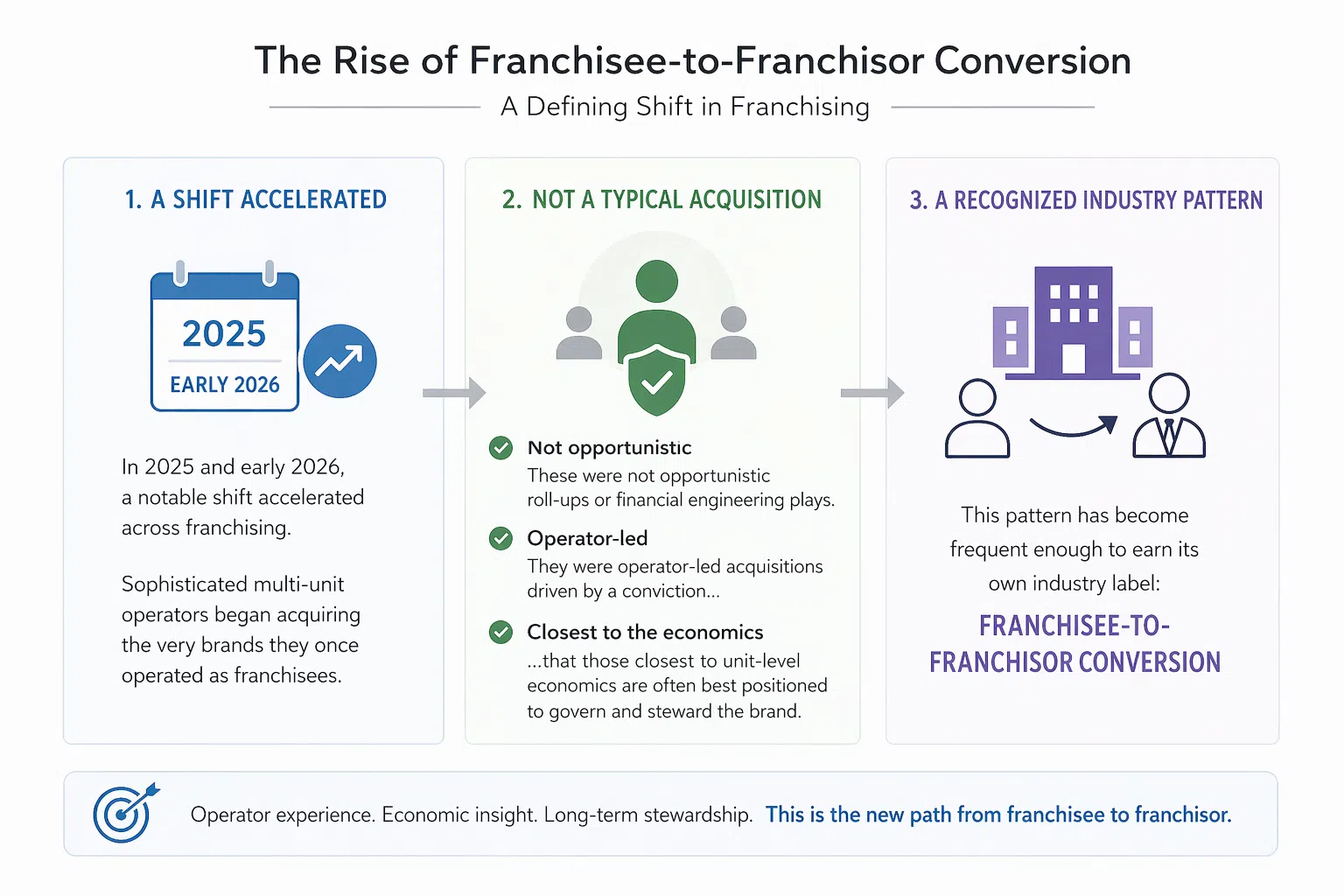
In 2025 and early 2026, a notable shift accelerated across franchising. Sophisticated multi-unit operators began acquiring the very brands they once operated as franchisees.
These were not opportunistic roll-ups or financial engineering plays. They were operator-led acquisitions driven by a conviction that those closest to unit-level economics are often best positioned to govern and steward the brand.
This pattern has become frequent enough to earn its own industry label: franchisee-to-franchisor conversion.
Recent Examples of Franchise Owners Acquiring Their Brands
Several high-profile transactions illustrate the scope and seriousness of this shift.
BRIX Holdings (Friendly’s, Clean Juice, Orange Leaf, Red Mango, Souper Salad)
In July 2025, Legacy Brands International, led by Amol Kohli, a major multi-unit Friendly’s franchisee, acquired BRIX Holdings. The deal transferred ownership of a diversified brand portfolio to a leader who had operated within the system.
Del Taco
In late 2025, Yadav Enterprises, one of the largest multi-brand franchise operators in the United States, reached an agreement to acquire Del Taco from Jack in the Box for approximately $115 million.
Denny’s
As of late 2025, a consortium of investment firms, including Yadav Enterprises as a prominent franchisee participant, entered a definitive agreement to take Denny’s private in a transaction valued at roughly $620 million, with closing expected in Q1 2026.
Big Blue Swim School
In 2025, the brand combined with its largest franchise partner, Atlanta-based L5 Swim, effectively placing brand control with its most experienced operator.
Hooters
During a 2025 restructuring, two existing franchisees were among the buyers who acquired a substantial ownership position to stabilize the brand and influence its future direction.
Modern Market Eatery
The brand was acquired by Thrive Restaurant Group, one of its experienced franchisees, as part of a deliberate shift toward owner-operator leadership.
Uncle Julio’s
The brand joined the portfolio of Sun Holdings, a leading multi-unit franchise operator that has increasingly transitioned from franchisee to brand owner.
Individually, these transactions may appear opportunistic. Collectively, they reflect a deeper structural pattern.
What “Franchisee-to-Franchisor” Actually Means
The term franchisee-to-franchisor conversion is not marketing language. It is a functional descriptor used by those closest to franchise operations and dealmaking.
It refers to a specific type of acquisition in which a franchise owner, typically a large multi-unit or multi-brand operator, acquires the franchisor entity or a controlling interest in the brand.
This is materially different from a traditional private equity buyout, even though private equity is often involved on both the buy and sell sides and frequently provides capital, structuring, or minority ownership in these transactions.
Who Uses the Term and Why It Matters
Industry Media
Franchise trade publications and sector-specific business outlets use the term to distinguish operator-led brand acquisitions from financially driven sponsor transactions.
Investment Firms and M&A Advisors
Advisors specializing in franchise transactions use the phrasing to signal that operational judgment, not just capital efficiency, is central to the ownership thesis.
Operational Experts and Consultants
Consultants and industry speakers use the term to separate these transactions from holding-company models, emphasizing leadership that understands franchise economics from direct operating experience.
A Historical Precedent: Jerry Richardson and the Original Operator-Led Conversion
While the current wave of franchisee-to-franchisor conversions feels contemporary, the model itself has a long and credible history.
One of the earliest and most consequential examples is Jerry Richardson, whose career illustrates the operator-led pathway from single-unit franchising to enterprise brand ownership.
Richardson began as a franchisee. In 1961, he and his college teammate Charles Bradshaw used Richardson’s NFL championship bonus to open the first Hardee’s franchise. Their company, Spartan Food Systems, expanded rapidly and became the largest Hardee’s franchisee, operating hundreds of locations.
Richardson’s transition from franchisee to brand owner began in earnest in 1977, when Spartan Food Systems acquired Quincy’s Family Steakhouse, funded through a public stock offering. This marked an early move from executing within a system to setting brand direction.
The conversion accelerated in 1987, when TW Services, the parent company Richardson led, acquired Denny’s on September 14, 1987, in a transaction valued at approximately $218 million. At the time of the acquisition, El Pollo Loco was already part of the Denny’s corporate structure, having been acquired by Denny’s Inc. in 1983. As a result, El Pollo Loco became part of the broader TW Services portfolio.
Following the Denny’s acquisition, Richardson became head of the Denny’s brand and, in 1989, was named Chief Executive Officer of the overall company. The organization was later renamed Flagstar Companies in 1993. Under Richardson’s leadership, Flagstar grew into the sixth-largest foodservice company in the United States, overseeing more than 2,500 restaurants across multiple brands.
By that point, Richardson had fully completed the franchisee-to-franchisor conversion. He was no longer an operator inside a system, but the chief executive responsible for governing multiple franchisor brands.
Richardson’s path foreshadowed what the market is rediscovering in 2025–2026: experienced operators often become the most credible owners of the brands they know from the inside.
A Related Pattern in Large QSR Systems
In larger, more established QSR systems, a parallel dynamic has existed for decades. Senior operations executives routinely move between franchisors, franchisee organizations, and competing brands as leadership teams rebalance scale, execution discipline, and growth priorities.
This circulation of operating leadership has long been accepted as a source of institutional knowledge and operating rigor within major QSR brands. What is changing now is not the credibility of operator-led leadership, but the level at which it is being applied. Increasingly, experienced operators are not just running brands on behalf of owners. They are becoming the owners themselves.
Why Operators Are Buying Brands
At its core, this shift reflects a growing recognition of where value is created and risk is absorbed in franchising.
Experienced operators understand unit-level economics in practice, not just on spreadsheets. They see how pricing, labor, marketing, supply chain, and real estate decisions perform in live stores. They have lived through brand initiatives that strengthened or weakened franchisee returns. They know which strategies scale cleanly and which quietly compress margins.
In many cases, these operators believe they can govern the brand with greater discipline because they remain accountable to the same economic realities as the franchisees they now oversee.
What This Signals for Franchise Systems
Franchisee-to-franchisor conversions are not an indictment of private equity or corporate ownership. They are a signal.
They indicate that operational credibility is becoming a decisive asset at the brand level. Franchisee confidence increasingly follows leaders who have carried operating responsibility themselves. Boards and sellers recognize the value of operator-led stewardship. The gap between franchisor decision-making and franchisee economics is now being reflected in transaction structures and valuations.
For franchise CEOs and boards, this trend raises a direct question:
Is brand leadership built around real operating accountability at the unit level?
In a growing number of transactions, the market’s answer is clear.
A Final Word for Franchise CEOs
If you are a franchise CEO watching experienced multi-unit operators step into brand ownership across the industry, the issue is not whether those transactions make strategic sense.
It is what happens after ownership changes hands.
More often than not, the challenge is how leadership decisions around governance, growth, and franchise recruitment are defined, tested, and enforced once a system transitions from one ownership mindset to another.
When those decisions are left implicit, or carried forward by habit, systems begin to lose coherence. Franchise Value Propositions blur. Ideal Franchise Candidate Profiles loosen. Investment tiers stop matching the realities of capital, capability, and execution in the field.
Over time, this weakens credibility with experienced operators and creates friction between franchisors and franchisees, even when intentions remain sound.
The recent wave of franchisee-to-franchisor conversions is simply a visible signal of a broader leadership test: who is structurally equipped to govern a franchise system in a way that reflects how the business actually performs at the unit level.
That includes tightening Franchise Value Propositions, defining disciplined Ideal Franchise Candidate Profiles, and recalibrating investment tiers so expectations are explicit, defensible, and consistently applied.
In practice, Chief Development Officers and VPs of Franchising often tell us they value having a structured, leadership-level way to address these challenges with their teams and boards, rather than relying on processes, technology, or reminders alone to maintain operator credibility and decision discipline.
If your objective is to protect brand integrity, attract serious multi-unit operators, and govern growth with confidence as your system evolves, it requires more than capital or activity.
It requires clear decisions, durable standards, and leadership accountability.
