

The Order-Taker Problem in Franchise Recruitment Development: How CEOs and CDOs Build Systems That Recruit Growth-Ready Operators
By Joe Caruso
Many franchisors believe they have a lead generation problem in franchise development.
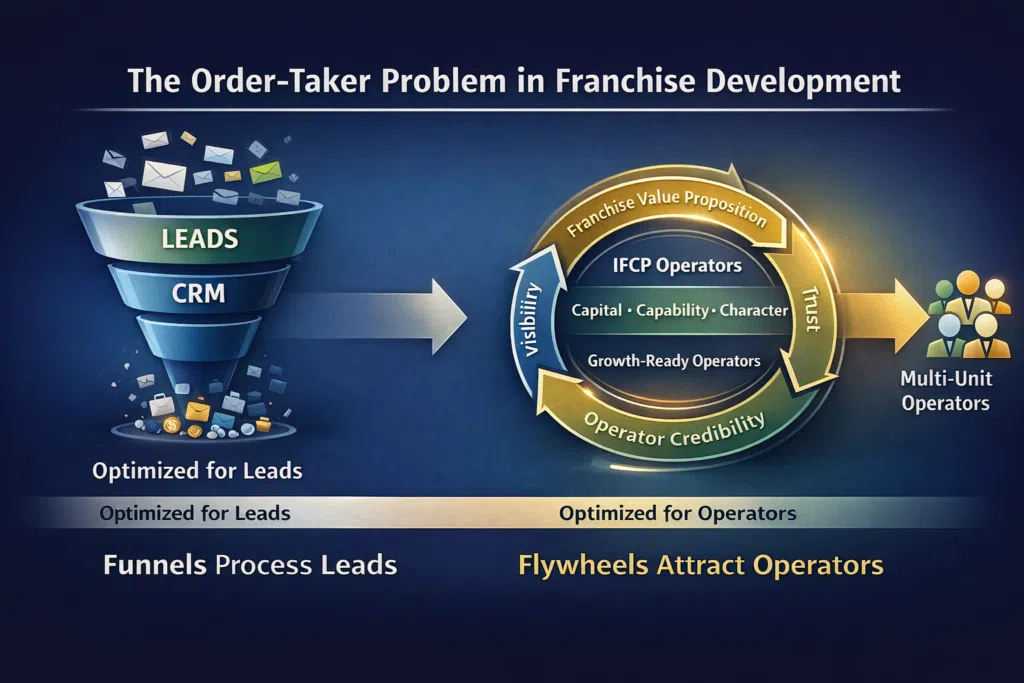
In reality, they have a development system that turns their franchise sales teams into order takers instead of builders of enterprise-level operator relationships.
The problem becomes most visible in organizations trying to recruit multi-unit, multi-brand operators (MUMBOs) and well-capitalized franchise owner-operators with designated operating partners.
Most CEOs and Chief Development Officers say this is exactly the profile they want.
Yet many development systems are still structured to attract first-time franchise buyers rather than scalable franchise owner-operators capable of building meaningful territory development.
The Real Issue Isn’t Lead Generation
When CEOs evaluate franchise development performance, the conversation often begins with marketing metrics.
How many leads did we generate? What did we pay per lead? Which portals are performing?
Those questions are understandable, but they can unintentionally focus leadership attention on the wrong part of the system.
Franchise development is not primarily a marketing activity.
It is a capital deployment and operator recruitment strategy.
Every franchise agreement represents a long-term partnership with a franchise owner-operator who will deploy capital, build locations, hire teams, and represent the brand in the market.
Understanding the challenges of franchise recruitment is essential for long-term success.
Seen through that lens, the central question changes.
Instead of asking how many leads the system produces, leadership begins asking:
Are we consistently identifying and recruiting operators capable of building the brand?
That shift in perspective is where the difference between order-taking development teams and order-getting development teams becomes clear.
The Difference Between Order Takers and Order Getters
In professional selling, the distinction between an order taker and an order getter is straightforward.
Order takers respond to interest.
Order getters create opportunity.
An order-taking development team spends most of its time:
- responding to inquiries
- sending information
- scheduling introductory calls
- managing leads inside a CRM
The candidate controls the process.
Order-getting development teams operate differently.
They:
- identify operators who match the brand’s Ideal Candidate Franchise Profile (IFCP)
- engage those operators intentionally
- ask probing questions to evaluate alignment
- guide candidates through a disciplined evaluation process
Instead of processing inquiries, they focus on building relationships with operators capable of executing the brand’s growth strategy.
A Pattern I’ve Seen Repeatedly
After more than three decades working in franchise development—from selling franchises myself to later leading development organizations—I’ve seen the same pattern repeat itself across different systems.
A brand invests in lead generation.
Portals begin producing inquiries. The CRM fills with prospects. The development team becomes busy responding to interest.
On the surface, it looks like progress.
But when leadership steps back and looks closely at the pipeline, something becomes obvious.
Very few of those candidates are actually capable of building the kind of multi-unit growth the brand is trying to achieve.
At that point the realization begins to set in:
The problem isn’t simply lead generation.
The problem is that the development system itself has trained the team to become order takers rather than order getters.
The Franchise Portal Illusion
Franchise portals can be useful exposure tools.
But they also train development teams to believe the job begins when a lead arrives.
That mindset quietly converts sales professionals into inquiry processors.
When portals dominate the pipeline, the daily rhythm of franchise development becomes:
- checking the CRM for new inquiries
- responding to portal leads
- following up on partially interested prospects
Activity increases.
But operator quality often does not.
This creates what might be called the franchise portal illusion.
The pipeline appears busy, but the development team is spending most of its time responding to curiosity rather than engaging serious investors.
The Cheap Lead Illusion
Lead aggregators often promote the idea that franchise recruitment can be scaled simply by increasing lead volume.
The economics can appear attractive.
For a relatively low cost per lead, franchisors can generate a steady flow of inquiries and quickly fill a CRM pipeline.
But low-cost leads frequently come with an unintended consequence.
They tend to attract individuals who are curious about franchising rather than qualified to operate a franchise system.
As a result, development teams may find themselves managing large volumes of inexpensive inquiries while spending relatively little time engaging the types of operators the brand actually wants.
Cheap leads make the pipeline look active.
But franchise systems are rarely built by the lowest-cost leads.
They are built by qualified operators capable of executing a development plan over time.
Cheap leads can fill a CRM pipeline.
They rarely build a franchise system.
The Inbox Lead Addiction
A second effect of portal-driven recruitment is what many development teams quietly recognize as inbox lead addiction.
Salespeople begin their day by checking their CRM or email to see what inquiries arrived overnight.
Instead of asking:
Who should we be talking to?
The question becomes:
Who contacted us today?
Over time, this conditions development teams to wait for opportunity instead of creating it.
The CRM Funnel Trap
CRM systems are essential tools.
But many organizations unintentionally use them in ways that reinforce order-taking behavior.
The traditional funnel mindset assumes a simple sequence:
Generate leads. Move them through stages. Close deals.
But franchise recruitment rarely behaves that way.
Enterprise operators often evaluate brands long before submitting an inquiry.
Much of the real decision-making happens before the candidate ever enters the funnel.
A Lesson From Early in My Franchise Development Career
Early in my career working in franchise development at Hardee’s, I became convinced that one of the most powerful places to recruit franchise owner-operators was inside our own restaurants.
We had thousands of customers walking through the doors every day—many of them successful local business owners and operators who already understood the brand.
My proposal was simple: promote franchising opportunities directly inside the restaurants through tray liners and in-store messaging.
But the idea met resistance from some large franchise owner-operators who were concerned about operational distractions.
The moment stuck with me because it revealed something important about franchise recruitment.
Visibility among the right operators often matters far more than generating anonymous leads.
The operators most capable of building a franchise system are frequently already observing the brand long before they ever contact the development team.
How Sophisticated Operators Actually Evaluate Franchise Brands
Enterprise-level operators rarely begin their evaluation by filling out an inquiry form.
Long before they contact a development team, they are studying the brand.
They observe leadership discussions. They read development announcements. They watch how the brand communicates with its operators.
By the time many operators reach out, they have already formed a strong point of view about the opportunity.
The development conversation is no longer about convincing a stranger.
It becomes a professional dialogue between the brand and an operator evaluating a potential partnership.
Why Development Teams Spend Most of Their Time With Candidates Who Will Never Qualify
In many organizations, development teams spend most of their time with candidates who will never qualify.
These prospects may be enthusiastic about franchising, but they often lack:
- sufficient capital
- operational capability
- multi-unit development capacity
- alignment with the brand’s territory strategy
When lead portals dominate the pipeline, development teams can end up spending the majority of their time managing curiosity rather than advancing serious investors.
This is why early qualification matters.
The most valuable asset in franchise recruitment is the time and attention of the development team.
Order-getting organizations protect that time carefully.
Many franchise development teams quietly know the truth: the majority of portal leads will never qualify to become franchise owner-operators—but the system still expects them to treat every inquiry like a serious opportunity.
The MUMBO Contradiction
Ask most CEOs and Chief Development Officers what type of franchise owner-operators they want, and the answer is consistent.
They want multi-unit, multi-brand operators (MUMBOs).
They want well-capitalized investors.
They want operators capable of developing entire territories.
Yet the recruitment systems many franchisors rely on are designed to attract first-time franchise buyers.
Enterprise operators rarely browse franchise listing portals.
They typically discover opportunities through:
- industry relationships
- referrals from other operators
- conversations with development leadership
- direct outreach from franchisors
The “Growth Ready” Standard
When evaluating franchise candidates, we often ask a simple question:
Are they growth ready?
Growth-ready operators are franchise owner-operators who have been financially and operationally verified to perform against the unit development commitments in their Area Development Agreement.
This means confirming:
- sufficient capital
- operational capability
- experienced designated operating partners
- alignment with the development schedule
Growth-ready operators are not simply interested in the brand.
They are prepared to execute the brand’s development strategy.
The Franchise Development Discipline Model
Strong franchise recruitment does not happen by accident. It happens when several disciplines reinforce each other.
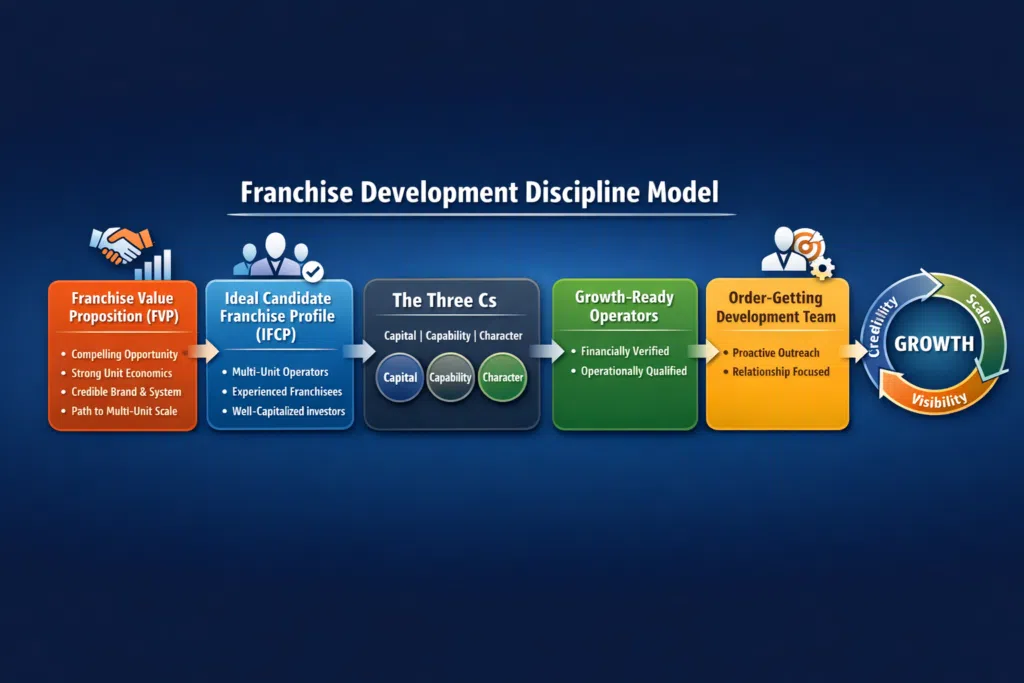
1. Franchise Value Proposition (FVP)
The foundation of franchise recruitment is a compelling Franchise Value Proposition:
- strong unit economics
- credible brand and operating system
- clear path to multi-unit scale
Without a strong FVP, recruitment efforts struggle to attract serious operators.
2. Ideal Candidate Franchise Profile (IFCP)
Leadership must clearly define the operators the brand is built for.
Typical IFCP characteristics include:
- multi-unit operators
- experienced franchise operators
- well-capitalized investors
3. The Three Cs: Capital, Capability, Character
Before advancing candidates, development teams evaluate:
Capital – financial resources Capability – operational experience Character – leadership and partnership mindset
4. Growth-Ready Operators
Before advancing candidates, development teams evaluate:
Capital – financial resources Capability – operational experience Character – leadership and partnership mindset
4. Growth-Ready Operators
Candidates who meet the IFCP and demonstrate the Three Cs can then be evaluated for growth readiness.
5. Order-Getting Development Teams
Order getters actively identify and engage operators who match the IFCP.
They do not wait for qualified candidates to appear in the CRM.
6. Flywheel Momentum
When these disciplines reinforce one another, recruitment stops behaving like a funnel and begins operating like a flywheel, where visibility, credibility, and operator relationships attract increasingly stronger candidates over time.
Order getters identify IFCPs, verify growth-ready operators, and feed a recruitment flywheel that strengthens the franchise system over time.
A CEO Diagnostic
Leadership teams should periodically ask:
- Are we recruiting IFCP operators?
- Are candidates demonstrating the Three Cs?
- Are they growth ready?
- Is our development team acting like order getters?
Because franchise systems don’t scale from lead volume.
They scale from qualified operators capable of executing the development plan.
Franchise portals generate inquiries.
Order-getting development teams generate operators.
The Leadership Decision
Franchise development teams become order getters when leadership builds systems that reward:
- intentional prospecting
- disciplined qualification
- advancing conversations on the calendar
- engagement with enterprise operators
Lead volume does not build franchise systems.
Enterprise operators advancing through a disciplined development process do.
Continuing the Conversation
If this is a discussion worth having inside your organization, you can reach Mike Webster, Ned Lyerly, or me directly on LinkedIn or at joe@franchisorsales.org
.
For a structured framework behind this work, Mike outlines it in “The Franchise Recruitment Flywheel: 7 Essential Elements.”
