

The Subway Development Story
Introduction
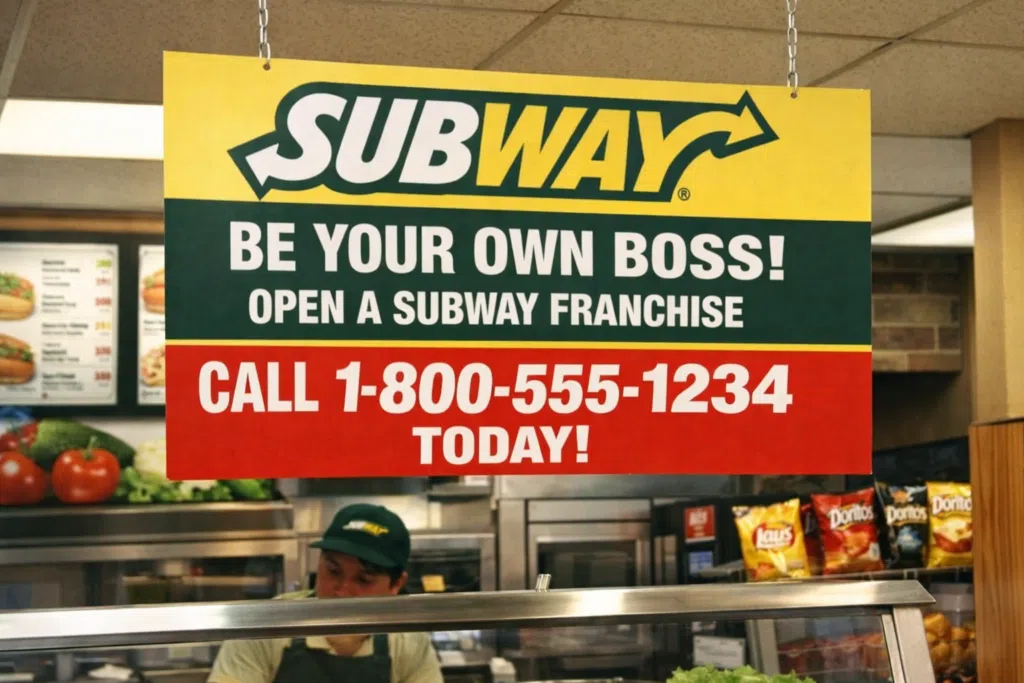
In the 1980s and 1990s, Subway quietly engineered one of the most powerful franchise development systems in history. It wasn’t just the use of a 1-800 number in-store—it was the integration of operations, visibility, and direct-response marketing into a single recruitment flywheel.
The Subway Development Method
Don Fertman, former Chief Development Officer at Subway described Subway’s development this way:
We actually would put mini-brochures in the stores along with actual menu panels, especially in markets where we had low penetration.
It was low-cost advertising and we had realized that most of our Franchisees had been customers, as you suspected.
We still did the trade shows, stayed away from brokers – our sales staff was in-house and our Development Agents recruited in their territories – and ran some advertising in places like the Wall Street Journal, which worked well when we did small ads on a regular basis.
So, every store became both:
- A revenue-generating unit
- A lead-generation engine for new franchisees
For Subway, this model scaled rapidly. But for today’s capital-intensive franchises ($2M–$8M investments), simply copying the tactic will not work.
How do you create a Modern Subway Effect but for complex, capital intensive brands?
The Subway Development success was not about signage—it was about alignment.
Three elements worked together:
- High Visibility – Constant exposure through dense store networks
- Broad Eligibility – A model accessible to many potential operators
- Immediate Action – Direct-response call-to-action (1-800 number)
This created a self-reinforcing loop:
More stores → More customers → More prospects → More stores
For capital-intensive concepts, the structure must change—but the logic remains.
Why Capital-Intensive Concepts Break the Subway Development Model
Most franchisors in the $2M–$8M range fail to replicate this system because:
- Traffic is lower but expectations are higher
- Prospect pool is much smaller (capital + experience constraints)
- Decision cycles are longer and more analytical
- Trust requirements are significantly higher
Putting a “Call us to franchise” message in-store is not enough.
You are not selling a sandwich shop.
If you are trying recruit multi-unit operators, you are selling:
- A multi-unit growth platform
- A capital allocation decision
- A long-term operating partnership
Reframing the Subway Development for Capital Intensive Franchising
To learn from the Subway Development model, you must redesign each component.
1. From Store Traffic → Qualified Attention
You do not need more eyeballs. You need the right eyeballs.
This means:
- Targeting experienced multi-unit franchise operators
- Engaging experienced franchisees from adjacent brands
- Attracting investors with operational partners
Mechanisms:
- LinkedIn content and events
- Industry-specific thought leadership
- Targeted outreach based on role and experience
Your “store traffic” becomes:
A selected audience of qualified operators
2. From Simplicity → Clarity of Economic Model
You cannot simplify the investment—but you can simplify understanding.
High-quality prospects require:
- Clear unit economics
- Defined path to scale (3–5 units, territory strategy)
- Operational support systems
Key shift:
Replace “low cost” with “clear, credible returns”
This is where most brands fail. They hide complexity instead of structuring it.
3. From 1-800 Number → Structured First Call
The modern equivalent of the 1-800 number is not a phone line.
It is:
A highly intentional, well-framed first conversation
This requires:
- A clear call-to-action
- Pre-framing the opportunity before the call
- Ensuring only qualified prospects book time
Examples:
- Register for a LinkedIn Live event
- Download a targeted investment brief
- Book a qualification call with context
But, the goal is the same as in Don Fertman’s Subway Development.
Convert attention into some more immediate action, which can be tracked for intention.
Enhancing the Subway Development Model
The original Subway Development model relied on anonymous customer traffic.
Today, you have an opportunity to dramatically improve on that model by combining or enriching:
- Customer data (POS, loyalty, reservations)
- A curated database of multi-unit operators to enrich the data
This creates a powerful new capability:
Identifying who your customers are—and which of them already have the character, capital, and capacity to become franchise operators.
From Anonymous Traffic → Identified Opportunity
Instead of treating customers as a homogeneous group, you can:
- Match customer emails, names, or behavioral patterns against known operator databases
- Identify individuals who already own or operate franchise units
- Detect “operator-adjacent” profiles (investors, managers, suppliers)
This transforms your system from:
Passive inbound interest
into:
Active identification of high-probability franchise candidates who already have an affinity your brand.
Practical Application
Examples of how this plays out:
- A loyalty member is identified as a multi-unit franchisee in another brand
- A frequent guest is part of an ownership group or investment network
- A high-spend customer shows patterns consistent with operator-level engagement
These are not leads in the traditional sense.
They are:
Pre-qualified, behaviorally validated prospects
Strategic Advantage
This enhancement solves a core limitation of the original Subway Development model:
- Subway generated volume but not necessarily quality filtering upfront
By contrast, your system can:
- Maintain continuous inbound flow
- Layer in qualification at the data level
- Prioritize outreach to the highest-value prospects
Integration with Your Existing Model
This aligns directly with your broader strategy:
- POS data → identifies brand affinity
- Multi-unit database → identifies capability
- LinkedIn → enables engagement and conversion
The combined effect is a new type of flywheel:
Operational data → Identified operators → Targeted engagement → Structured calls → Multi-unit deals
The New Flywheel
When properly aligned, the system looks like this:
- Thought Leadership & Content → Attracts qualified operators
- Live Events & Engagement → Builds trust and credibility
- Structured First Call → Converts interest into pipeline
- Multi-Unit Deals → Expands footprint
- New Locations → Generate proof and new attention
Then the cycle repeats.
Embedding Franchise Development Into Operations
This is the most important shift.
Subway embedded recruitment into the store unit level.
You must embed recruitment into:
- Your content
- Your leadership visibility
- Your operating performance
Every unit needs to answer the question:
“Why would a sophisticated operator invest here?”
Case Insight: From Passive Interest to Active Pipeline
A typical capital-intensive brand relies on:
- Brokers
- Portals
- Trade shows
These are episodic and disconnected from operations.
By contrast, your updated Subway Development system:
- Generates continuous inbound interest
- Filters for quality early
- Builds relationships before the first call
The result is not more leads.
It is:
Fewer, better, faster-moving opportunities
Design Principles for Implementation
To operationalize this model, follow five principles:
1. Proximity
Bring the prospect as close as possible to the real business.
- Live discussions
- Operator interviews
- Real performance insights
2. Credibility
Demonstrate—not claim—performance.
- Data-backed storytelling
- Transparent economics (within legal bounds)
3. Selectivity
Make it clear that not everyone qualifies.
- This increases perceived value
- Attracts serious operators
4. Continuity
Avoid one-off campaigns.
- Build ongoing content and engagement systems
5. Conversion Discipline
Treat the first call as a critical “sale.”
- Structure it
- Prepare for it
- Qualify rigorously
Conclusion
The Subway Development model was never just about a phone number.
It was about:
Turning everyday business activity into a continuous, self-reinforcing franchise development engine
For capital-intensive concepts, the tools have changed—but the strategy remains.
If you can align:
- Qualified attention
- Clear economic storytelling
- Immediate, structured action
You can recreate the same flywheel.
Not for $200,000 per unit.
But for the capital intensive $2M–$8M unit.
What to do Next
If you are a franchisor looking to build a modern franchise development engine, the first step is diagnosing your current funnel:
- Where are your prospects coming from?
- How are they being qualified?
- What is your true conversion point?
Because the real question is not:
“How do we get more leads?”
It is:
“How do we build a system where the right operators come to us—and act?”
