

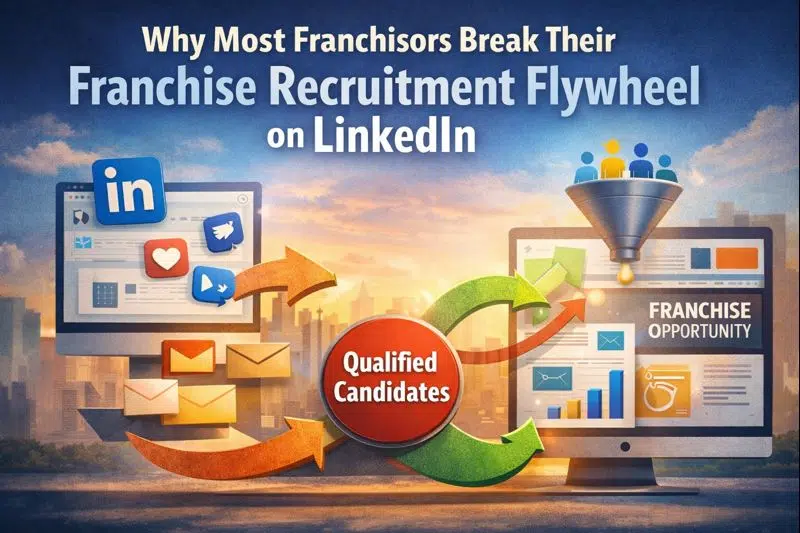
Why Most Franchisors Break Their Franchise Recruitment Flywheel on LinkedIn
By Joe Caruso
Most franchisors do not fail on LinkedIn because the platform does not work. They fail because they quietly break their franchise recruitment flywheel and never realize it.
LinkedIn, email, and the franchise recruitment website are typically treated as separate efforts. Different people manage them. Different metrics are used to judge them. Different expectations are placed on each. The result is activity without momentum and visibility without progress.
Franchise recruitment does not stall because of a lack of content. It stalls because the system that should convert attention into qualified conversations is fragmented.
When the flywheel is broken, every post, campaign, and follow-up feels like starting over.
The Franchise Recruitment Flywheel Explained Simply
A flywheel works when each turn makes the next turn easier.
In franchise recruitment, the flywheel should look like this:
- LinkedIn creates informed awareness and credibility
- That awareness leads to clear, voluntary opt-ins
- Opt-ins feed an email relationship that deepens understanding
- Email drives candidates back to the website with context and intent
- The website advances decision-making and prompts real conversations
- Those conversations inform future messaging, content, and outreach
When this system is intact, momentum compounds. Over time, candidates arrive better educated, sales cycles shorten, and the quality of conversations improves.
Most franchisors break this flywheel in three predictable ways.
Failure #1: Treating LinkedIn, Email, and the Website as Separate Channels
LinkedIn is often treated as a branding tool. Email is treated as a nurture tool. The website is treated as a static destination.
Each is planned and evaluated independently.
That separation is the root problem.
LinkedIn should not exist to generate impressions. It should create interest that leads somewhere specific. Email should not exist to reintroduce the brand. It should continue a conversation already in motion. The website should not function as a brochure. It should help candidates self-qualify and move forward with clarity.
When these channels are disconnected, candidates leak out of the system at every handoff. Momentum never builds because energy applied in one place does not reinforce the rest of the system.
A flywheel cannot work if its parts are misaligned.
Failure #2: Measuring Activity Instead of Momentum
Another common breakdown happens in how performance is measured.
Franchisors often track:
- LinkedIn impressions and engagement
- Email open and click rates
- Website traffic and page views
These are not useless metrics, but they are incomplete.
The real question is not whether each channel performs well on its own. The real question is whether each turn of the system reduces friction in the next.
For example:
- Does LinkedIn activity lead to new, opted-in contacts?
- Do those contacts engage with follow-up email and return to the website?
- Do website visits result in better-informed inquiries?
- Do sales conversations become more focused and productive over time?
If every step requires the same amount of effort as the first step, the flywheel is not spinning. You are manually pushing disconnected parts instead of benefiting from accumulated momentum.
High-performing recruitment systems feel lighter as they mature, not heavier.
Failure #3: Failing to Replenish the System With Opted-In Leads
One of the most damaging mistakes is relying on aging email lists while running active LinkedIn programs that do not convert attention into permission.
Many franchisors depend on lists built from:
- Old lead portals
- Past discovery days
- Inactive inquiries
- Third-party sources
At the same time, they post on LinkedIn, host events, and publish content without a clear path for interested prospects to raise their hand.
When LinkedIn does not replenish the system:
- Email lists decay
- Follow-up becomes forced instead of welcomed
- Sales teams chase colder leads
- Recruiting becomes outbound-heavy and inefficient
LinkedIn events, articles, and commentary should serve a secondary purpose beyond visibility. They should consistently introduce new, opted-in contacts into the system.
Without that renewal, the flywheel slows no matter how polished the content appears.
What High-Performing Franchisors Do Differently
Franchisors who succeed on LinkedIn do not think in channels. They think in systems.
They design LinkedIn activity to:
- Speak directly to defined Ideal Franchise Candidate Profiles
- Reinforce a clear Franchise Value Proposition (FVP)
- Attract the right operator tier, not the widest audience
- Create natural transitions into email and deeper engagement
They measure success by:
- The quality of conversations, not volume of impressions
- Shorter sales cycles and better-prepared candidates
- How much easier it becomes to recruit the right franchisees over time
Most importantly, they treat LinkedIn, email, and the website as a single recruitment engine, not three separate tools.
High-performing franchisors also accept a hard truth: franchise recruitment flywheels fail when sales teams are not trained, coached, and actively developed to operate them. Tools and content do not substitute for judgment, sequencing, and disciplined follow-up. Without ongoing coaching and mentoring, even well-designed systems break down over time.
A Final Word for Franchise CEOs
If you are a franchise CEO and your development team is generating plenty of activity but still struggling with candidate quality, stalled deals, inconsistent momentum, or difficulty attracting the hard-to-get, highly sought-after Multi-Unit Multi-Brand Operators (MUMBOs), the issue is rarely effort.
More often, it is the absence of a coherent recruitment system and the leadership structure required to run it well across LinkedIn, email, and your franchise recruiting website.
Michael (Mike) Webster, PhD, Ned Lyerly, and I work with franchise leadership teams to design and operate the Franchise Recruitment Flywheel, and to help sales leaders train, coach, and hold their teams accountable for executing it consistently and well.
If you want a recruitment system that produces better-qualified operators, protects brand standards, compounds over time, and consistently appeals to experienced multi-unit and multi-brand operators, it requires more than tools or content. It requires clear leadership, disciplined coaching, and ongoing accountability.
Reach out to Mike, Ned, or me to start a serious conversation.
For the full framework behind this approach, Michael (Mike) Webster, PhD lays out the complete model in his article:
The Franchise Recruitment Flywheel: 7 Essential Elements
